Golf simulator enclosures: framed vs retractable vs foldable
Framed, kit, retractable and foldable golf simulator enclosures compared by cost, footprint, install time, impact protection and the room each one suits.
- Topic
- Enclosures
- Published
- Read
- 7 min
- Carry
- 1,549 words
In this guide 8 sections
- How do the four enclosure types compare?
- When is a pipe-frame kit the right call?
- How does a retractable enclosure work in a garage?
- Do foldable golf simulators make sense?
- What does a permanent framed simulator room involve?
- Which enclosure should you choose for your room?
- What else does an enclosure decision affect?
- Questions people ask
Golf simulator enclosures come in four types: a permanent framed room, a pipe-frame kit, a ceiling-mounted retractable system and a fold-away cabinet. A kit is the cheapest complete option at roughly $1,000 to $5,000. A retractable is the usual pick for a garage that still parks cars. A fold-away cabinet costs the most for what you get, but closes to about 2 feet off the wall. A framed room looks the most finished and depends on padding for protection. The right one depends less on budget than on whether the room has to do anything else.
Prices checked November 2026.
How do the four enclosure types compare?
| Permanent framed | Pipe-frame kit | Retractable motorized | Foldable or portable | |
|---|---|---|---|---|
| Typical cost | Quoted by the job; padding alone about $10-18/sq ft for branded panels | About $1,000-4,600 before pipe | About $2,400-6,100, plus mounting | About $2,350 for a collapsible bay; about $11,200 and up for a wall cabinet |
| Footprint when not in use | Permanent | Permanent; comes apart with effort | Rolled up at the ceiling | About 24 in deep closed (cabinet), or packed away |
| Install time | Days to weeks of carpentry | A day or two | About a day, including motor limits | Professional install (cabinet); quick setup by hand (collapsible) |
| Impact protection | Only what you pad | Side panels, ceiling baffle, foam on the frame | Screen and side curtains; ceiling above needs checking | Built into the unit; walls beyond it are on you |
| Looks | Most finished | Clean, but reads as a frame | Clean when stowed | Furniture-like when closed (cabinet) |
| Best room | Dedicated room or new build | Basement or garage that's sim-only | Garage or bonus room with daily other use | Rooms that can't give up the ceiling |
All four types still need the same room underneath them. Start with about a 9 ft ceiling, 12 ft of width and 17 ft of depth. The room dimensions guide covers what you can get away with below those numbers.
When is a pipe-frame kit the right call?
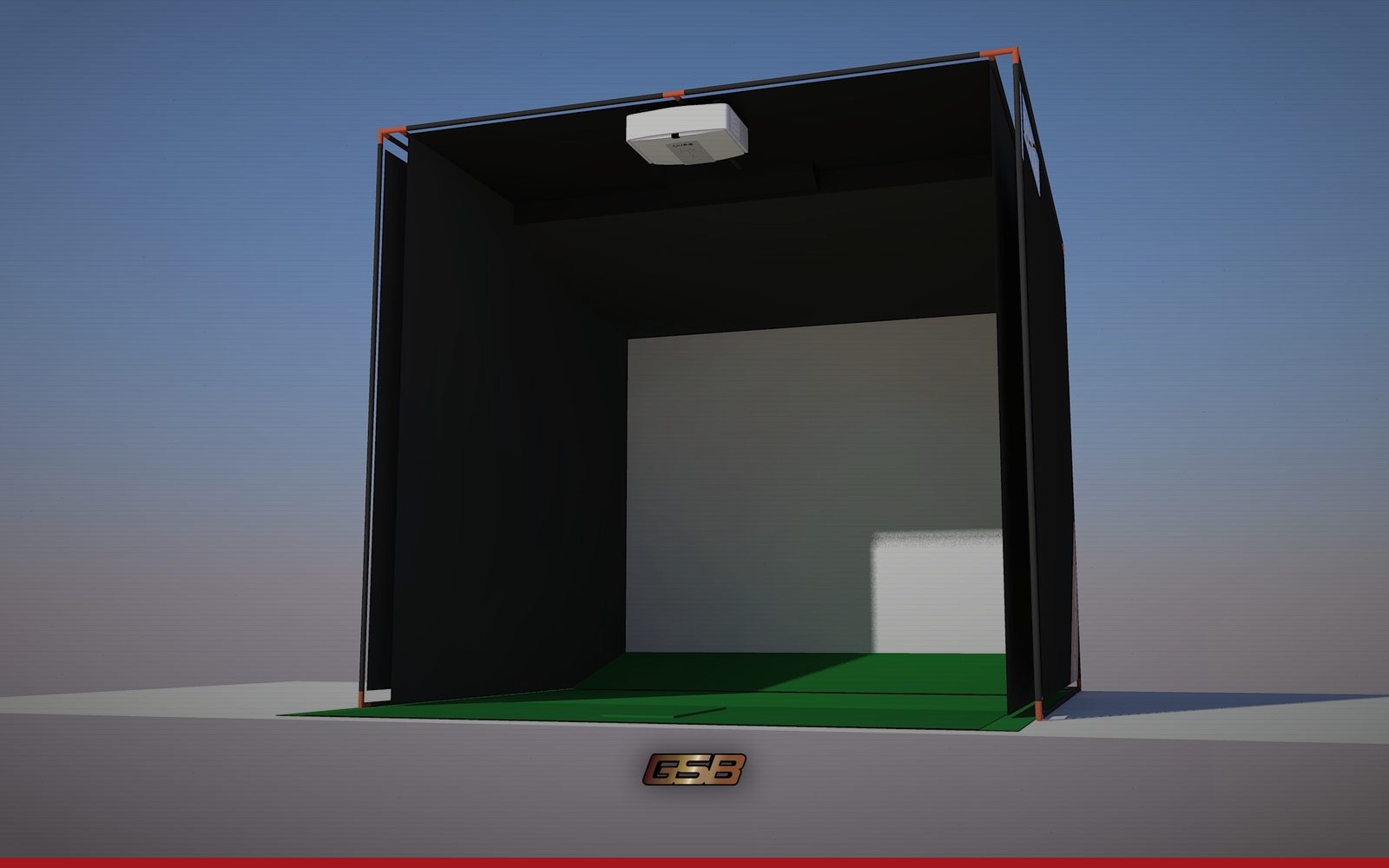
A kit is the default for a room that only does golf. It's a steel frame with an impact screen at the front, black side panels, a fabric ceiling baffle and foam sleeves on the front pipes. A mishit hits fabric, not drywall, and the sizes are matched so you aren't guessing at fittings.
- Carl's Place DIY kit: about $1,000 to $1,200 with a standard screen. Uses 1-inch EMT you buy locally, or their pipe kit.
- Carl's Place Pro kit: about $3,000 to $4,600 at dealers depending on size, before pipe. It uses 2-inch EMT, has a one-piece wraparound cover for the sides and ceiling, and its frame is built to carry a projector or overhead launch monitor on an optional crossbar. Carl's Place says the wraparound cover cuts setup from about three hours to two.
- SIGPRO SIG10 (The Indoor Golf Shop): about $1,600 to $2,600 depending on the seller and sale.
- SimSpace UltraMAX: $1,899.99 on SimSpace's US store.
- Rain or Shine SwingBay: about $2,500 on sale ($3,499 list) for the 8 x 10.5 ft size, with a 9 x 12 ft option for $500 more.
Prices on all of these move with size and screen material, and dealers run sales often. Compare the screen grade and enclosure depth, not just the total.
Pick a kit if: the room is dedicated, you want the most protection per dollar, and you're fine with a visible frame. Skip it if: the space has to park a car or host something else most days.
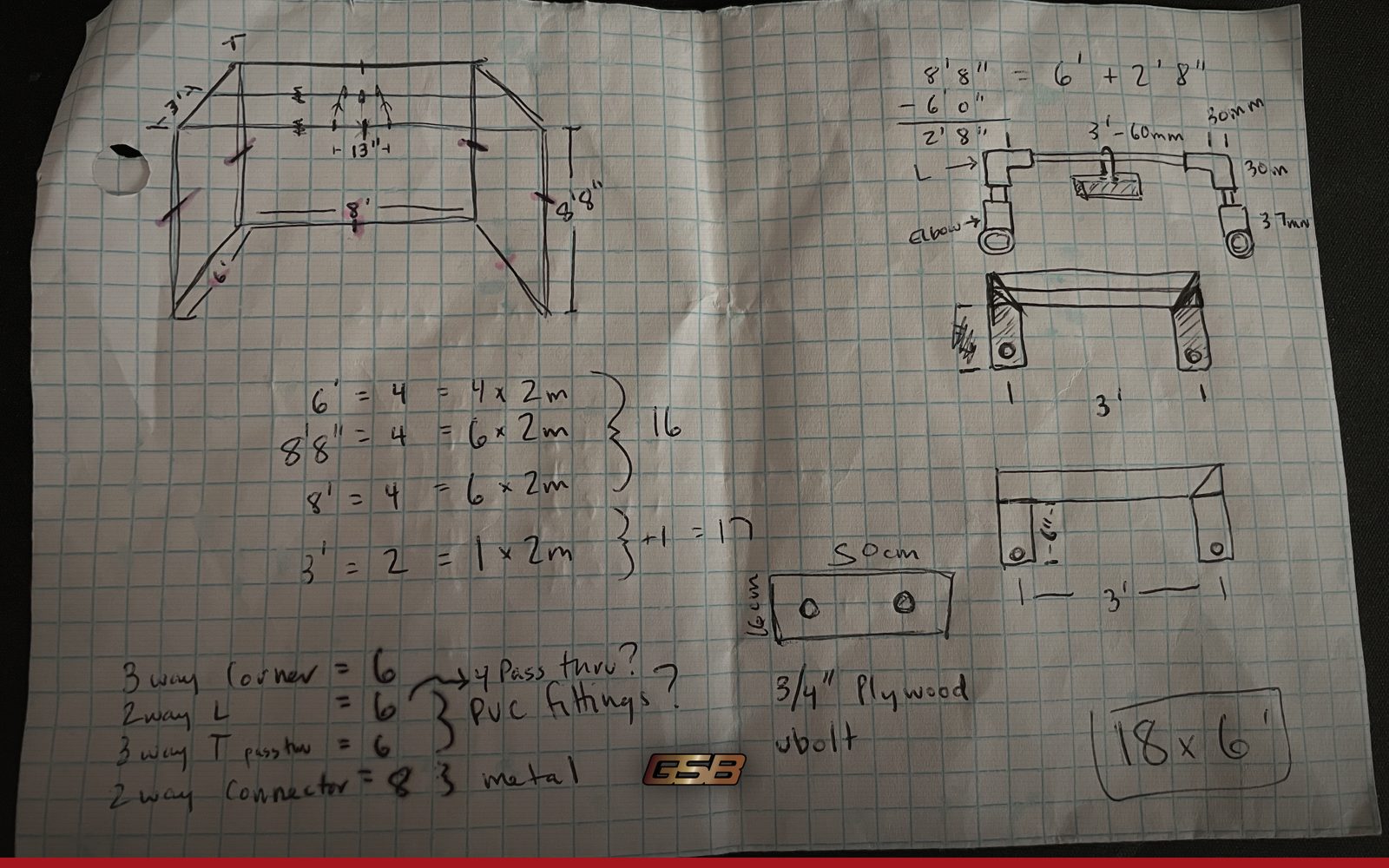
If you'd rather build the frame yourself from EMT and fittings, the DIY enclosure guide has the cut list, fittings and screen tensioning steps.
How does a retractable enclosure work in a garage?
A retractable system mounts rollers to the ceiling: one for the impact screen and one for each side curtain, each with its own motor or a hand crank. Press a button and everything drops into place. Press it again and it rolls back up, usually in under a minute. The projector stays on its ceiling mount, the turf rolls to the wall, and the cars come back in.
- GungHo retractable impact screen: from $2,699 on GungHo's site. Screens are sized to the room, and one reseller lists a custom unit at $4,104, so confirm what your quote includes, especially side curtains.
- SportScreen Vanish: about $2,400 to $6,100 depending on size and whether it's motorized or hand-crank. A semi-retractable Vanish LITE costs less. Ace has listed a working space of 12 to 17 ft wide, 17 ft long and 9 to 11 ft 5 in high for the Vanish range.
What to get right when you mount one
- Measure clear width, not garage width. Cabinets, shelving, the electrical panel and the water heater all cut into the span the brackets need.
- Anchor into joists only. A screen under tension is heavy. Use the brackets themselves as drilling templates, and hang the tube temporarily to check position before the final screws go in.
- Set the motor limits before the fabric goes on, then run a few more cycles after. The added weight changes how the motor stops.
- Keep the rolled screen out of the beam. Run a full up-and-down cycle with the projector on and make sure nothing hits the projector or an overhead launch monitor on the way.
- Check the ceiling above the hitting area. Side curtains catch shanks, but a skied wedge goes up. If there's no top baffle, pad or cover that part of the ceiling.
Pick a retractable if: the room has a daily second use and solid ceiling framing. Skip it if: the ceiling is low enough that the rolled tube eats your swing height, or the joists don't run where the brackets need to go.
Do foldable golf simulators make sense?
"Foldable" covers two very different products.
Wall-folding cabinets
The Murphy enclosure, sold through Ace Indoor Golf, works like a Murphy bed: the screen and side panels fold into a cabinet that sits about 24 inches off the wall when closed. Ace listed it from $11,199 in 2025, so confirm the current price. The catch is the open footprint. The Murphy 8 cabinet is 8 ft 10 in wide, but Ace lists the space needed to use it as 13 ft wide, 10 ft high and 17 ft deep. You save floor space when it's closed, not swing space when it's open.
Collapsible and portable bays
Freestanding bays that fold for storage, such as the Impact Sports foldable golf bay (9 ft 10 in x 8 ft 6 in x 8 ft 2 in, about $2,350 at one retailer), are the other end of the scale. They suit renters and rooms you can't drill into. Check the screen quality and how the frame handles a full-speed driver before buying one for daily use.
Pick a foldable if: the room is a living space that can't give up the ceiling or the floor, and the budget allows it. Skip it if: a retractable would fit. It does the same job for a fraction of the price.
What does a permanent framed simulator room involve?
Here the enclosure is the room itself. Walls are framed or furred out, the screen sits in a built-in surround, the projector and launch monitor are recessed or boxed into the ceiling, and padding covers every hard surface a ball can reach. It's how high-end rooms and new builds are usually done, and it's priced like a remodel.
The important difference is protection. A framed room has no fabric side panels unless you add them, so the padding is the containment. Branded memory foam panels run about $10 to $18 per square foot. A single 12 x 10 ft side wall is 120 square feet, or about $1,200 to $2,200 in panels. DIY foam with outdoor carpet can come in around $3 to $5 per square foot.
Pick a framed room if: the simulator is permanent, you want it to look built in, and you're already doing construction. Skip it if: you might move or reconfigure the room in a few years.
Which enclosure should you choose for your room?
| Your situation | Enclosure type |
|---|---|
| Basement or bonus room used only for golf | Pipe-frame kit |
| Garage that still parks cars on weeknights | Retractable |
| Living room or office with no spare ceiling | Wall-folding cabinet |
| Rental or a room you can't drill into | Collapsible freestanding bay |
| New build or full remodel | Permanent framed room |
| Overhead launch monitor planned | Kit with a projector/monitor crossbar, or a framed room; with a retractable, check roller clearance first |
What else does an enclosure decision affect?
- Projector position. The screen's distance from the lens sets which throw ratio works. Decide the enclosure, then pick from the projector guide.
- Launch monitor choice. Overhead units like the ProTee VX need a fixed mounting point that the enclosure or rollers can't block. Floor units don't care. See the launch monitor guide.
- Budget. The enclosure is a mid-sized line item, but it decides how much padding and finish work follows. The golf simulator cost breakdown shows where it sits in each tier.
- Planning order. Measure, then power, then hardware. The planning checklist puts the enclosure in that sequence.
Launch House has a longer enclosure guide with padding options for custom rooms. For screens, turf and other enclosure posts, see the enclosures section.